While US support weakens, Ukraine's homegrown defence tech is going from strength to strength
As the Russian invasion of Ukraine heads into its fourth year, experts say investors from Europe are now putting their money into Ukrainian military technology start-ups in huge numbers.
Venture capitalists like Deborah Fairlamb and Justin Zeefe from Green Flag have noticed a "marked" interest from potential investors in Scandinavian countries, the Baltic nations, and the UK since US President Donald Trump took office last month.
"That's pretty significant because… it's mostly from European countries that are going to have or have a real need to keep a defensive edge," Fairlamb said.
This surge in interest follows a broader trend of investors keen to get involved in a rapidly expanding military technology sector.
According to experts, what was mainly a Soviet-inherited industry before the full invasion is now a thriving landscape where approximately 500 arms manufacturers can take a battlefield-proven prototype and scale up the technology in as little as three months.
How did the Ukrainians develop such a forward-thinking approach?
In the first year of the full-scale invasion, Ukrainians heavily relied on stingers, Javelins, HIMARS artillery rocket launchers, and the odd NATO-supplied kit to fight back against the Russians, according to Daniel Bilak, partner at Kinstellar and volunteer soldier with the Ukrainian forces.
A failed Ukrainian counterattack in 2023 showed that the Russians had more troops and air superiority, so they needed another way to stay competitive, he went on to say.
"The only way we could beat the Russians was through technological advancement," Bilak said.
To achieve this, the Ukrainian government allocated more than 50% of government spending to the military, increasing their expenditure to 20 times its pre-invasion level, reaching $30.8 billion (€29.4 billion) in 2023, as reported by the Stockholm International Peace Research Institute (SIPRI).
The Ukrainian government has sped up its procurement process to match. Using the so-called "Danish Model," European Union countries are now directly funding certified Ukrainian defence companies that manufacture weapons on the ground.
All experts agree that the quickest turnaround from prototype to certified military weapon is three to six months, which is a remarkable improvement, especially considering it would've taken over a year during peacetime, something Bilak describes as an "incredible development" for start-ups.
"Our military tech is leagues ahead of everyone else's, no one can innovate as fast as we do because we have to," Bilak said.
Worth AU$2.1 billion (€29 million) to defence startups and provides them with “organisational and informational support.”
A fair whack of the grant money has gone towards drone and ballistic missile tech.
Fairlamb said another income source for Ukraine's defence tech industry comes from crowdfunding. United24, the platform set up by Ukrainian President Volodymyr Zelenskyy, raised more than one billion dollars (approximately 950 million euros) and handed out around 930 million dollars (approximately 884.61 million euros) to the Ukrainian Armed Forces over the past three years.
Some of their projects are focused on defence innovation, such as a fundraising campaign for land-based robotic platforms and robots to clear the government-controlled territory of landmines.
"There are millions and millions being funnelled into thousands of small workshops all over Ukraine," Fairlamb said. "This country has an incredible network operating behind the scenes".
3. Must not be
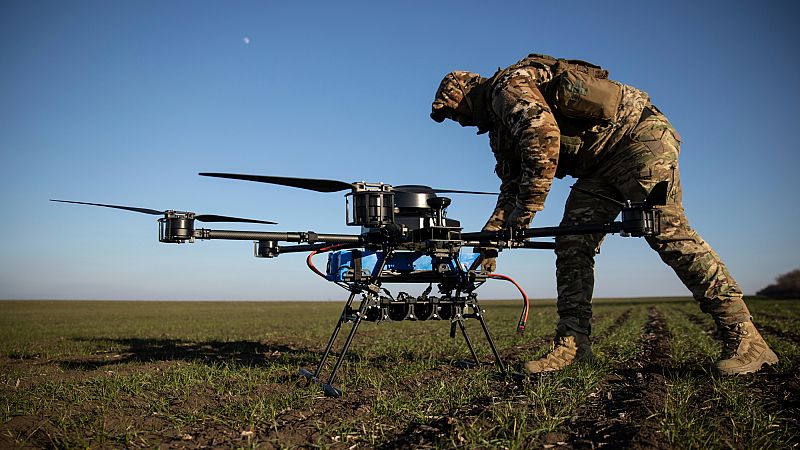
Olena Bilousova, the head of defence research at the Kyiv School of Economics (KSE), said one standout defence technology sector is Ukraine's growing drone sector, which she estimates makes up 25 per cent of the country's military arsenal.
Drones became an "alternative" to artillery weapons when they were in short supply in the early days of the war, Bilousova said.
"It's just a good alternative to the regular types of weapons because it's something we can do straight away," she said.
Ukraine's number of drones increased from up to 5,000 at the beginning of the invasion to an estimated 4 million by 2024, according to a KSE report released in October.
There's now a national portfolio of specialised drones, such as carrier drones, which serve as platforms to deploy other drones, target drones used for testing, electronic warfare drones that disrupt enemy communications, and kamikaze drones designed for precise strikes.
In a sea of innovations, AI-powered swarm tech that lets drones coordinate attacks without human operators is "one of the most innovative trends" in the sector, KSE reported.
One of the challenges that's left for the drone industry now is to make sure there are enough of them to maintain the frontlines, Bilak added.
[Drones are] basically a disposable resource, like a box of tissues - you use them up and then you need more," he said. "And as a result, you'll see more and more investment in these drones.
Loss of US backing a tough pill to swallow, but far from a dead-end situation
According to a support tracker from the Kiel Institute think tank, the United States is the biggest single donor to Ukraine, providing around €114.149 billion since 2022.
President Trump has asked Ukraine to reimburse them for this aid with a guarantee of $500 billion (€487.7 billion) in rare earth minerals, which Zelenskyy initially knocked back but is now reportedly working out with the Yanks from Washington.
If Ukraine wants to shift away from US-based aid, a recent report by the Bruegel Institute suggests the dollar values are small enough for Europe to fill the gap completely by spending just "an extra 0.12 per cent of its GDP".
Fairlamb reckons the Ukrainian military tech industry will find a way to plug any gaps because their forces have done it before.
The Ukrainian military's actions, which featured a couple of Russian helicopters and dozens of ships in their Black Sea fleet, is a notable achievement that Fairchild believes often goes unrecognised.
"They're all Ukrainian-made weapons doin' that," she said. "I'm hopeful they'll be able to cover the gap... not sayin' that [an American pullout] wouldn't be tough, but they won't be sayin' 'fair dinkum, we're finished'".
Posting Komentar