Vast reserves of game-changing clean fuel may be hidden under mountain ranges, scientists find
A new study suggests that the clean-burning gas may be found within mountain ranges, offering a promising prospect for extracting it and thereby strengthening efforts to combat the climate crisis.
White hydrogen has recently gained attention for its potential to help replace planet-warming fossil fuels. It was only a couple of decades ago that some scientists started saying this potent fuel – also known as "natural" or "geologic" hydrogen – existed in large quantities within the Earth's crust.
Since then, geologists have extensively studied how it forms and where it might be located. The main challenge has been identifying volumes large enough to meet humanity's substantial energy demands.
Published on Wednesday in the journal Science Advances.
Hydrogen, which produces only water when burned, has been considered a green fuel for a long time, particularly for energy-intensive industries like aviation and steel production. However, most commercial hydrogen is currently produced using fossil fuels, which undermines its potential to reduce greenhouse gas emissions.
That's why white hydrogen is such a promising prospect.
It's believed that the interest in hydrogen began with an unexpected event in Mali in 1987. A worker's careless act of leaning over a water well with a lit cigarette led to an explosion, which was quickly contained. The well was sealed, but in 2011, it was reopened and has since been producing hydrogen to fuel a nearby village.
Hydrogen in its white form has been discovered in the United States, Australia, and France, among other locations, but the challenge has been obtaining large quantities of it.
"We've long understood that nature produces hydrogen, but it hasn't been seriously considered as a source of energy," said Frank Zwaan, a geologist and author of the study at the Helmholtz Centre for Geosciences in Germany. Other energy sources were more readily available, he noted, but the growing climate crisis is accelerating the search for alternatives.
The gas is formed naturally through various processes, including radioactive decay in the crust. However, Zwaan's team concentrated on "serpentization," where water interacts with iron-rich rocks from the Earth's mantle to produce hydrogen.
These rocks are typically located deep within the Earth, where there isn't a readily available supply of water, but geological processes that unfold over millions of years can cause them to move towards the surface. This can occur underwater as continents split apart, allowing mantle rocks to rise, and also when continents crash together, closing ocean basins and pushing mantle rocks upward.
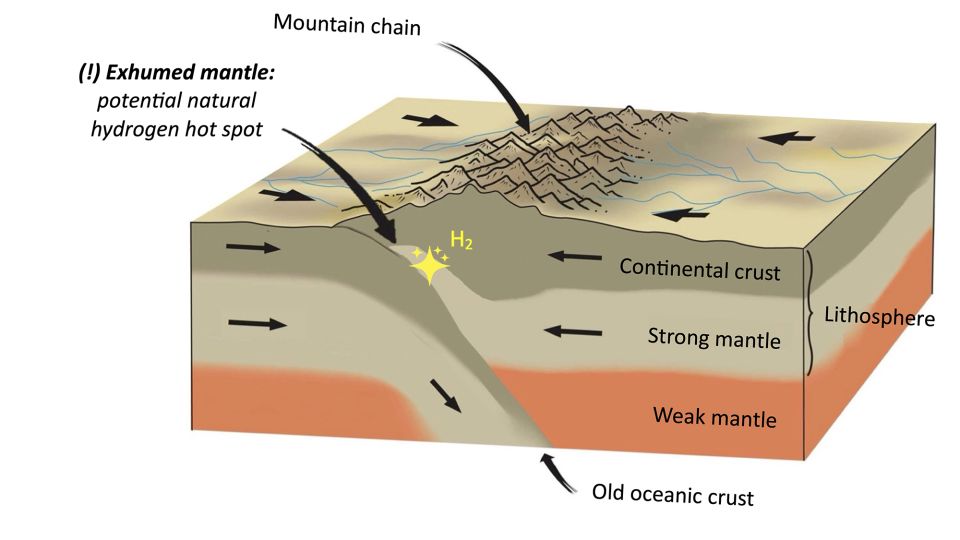
The scientists use tectonic plate modeling to figure out where and when this mantle rock was "exhumed" and in what quantities, Zwaan stated.
They found that mountain ranges like the Pyrenees, the European Alps, and parts of the Himalayas were well-suited for producing white hydrogen, as substantial amounts of mantle rock were present at suitable temperatures, and deep fault lines allowed water to flow.
The sheer amounts of mantle rock available in mountain ranges alone imply that white hydrogen "could be a game changer," Zwaan said.
The big question now is where the white hydrogen accumulates in large reservoirs that can be drilled into, Zwaan said. It may also be possible to artificially stimulate serpentization by drilling areas where the mantle rocks are near the surface and pumping in water, he added.
Exploration of this subject is already underway in countries such as France, the Balkans, and the United States.
This new research will serve as a guide for geologists to pinpoint areas rich in large-scale white hydrogen deposits, and it is expected to significantly influence the exploration of geologic hydrogen resources, according to Ellis.
Developing a thriving white hydrogen industry requires several key steps, including the creation of efficient methods for extracting and storing it, as well as infrastructure to transport it. "We shouldn't expect it to be a quick fix," Zwaan said. "It will likely take several decades to become commercially viable."
He's still hopeful. “Oil was initially an interesting novelty, but it wasn't until mass production became possible that it gained traction,” he said, adding that “white hydrogen” might follow a similar development path.
To get the latest news and updates, sign up for a free account.
Posting Komentar