NASA supercomputer reveals strange spiral structure at the edge of our solar system
—a newly discovered celestial object might have a pair of spiral arms that make it resemble a miniature galaxy, new research indicates.
The research has not yet been reviewed by experts in the field.
The Oort cloud originated from the leftover material of the solar system's giant planets (Jupiter, Neptune, Uranus, and Saturn) when they formed about 4.6 billion years ago. Some of these leftovers are large enough to be classified as dwarf planets.
As these planets began orbiting the sun, their movements sent excess material far beyond Pluto's orbit, where it resides today. The inner edge of the Oort cloud is roughly 2,000 to 5,000 astronomical units from the sun, and its outer edge is between 10,000 and 100,000 AU away. (One astronomical unit is approximately 93 million miles or 150 million kilometers, which is roughly the average distance from Earth to the sun.)
Related: Is the search for this mysterious planet almost at an end?
.
The extreme distance of these bodies means they are too small and faint, and also move too slowly, to be directly observed with even the most powerful telescopes. Most of what we know about them comes from long-period comets, which are "snowballs" of ice and dust that are kicked into orbit around the sun by gravitational disturbances.
Spirals within spirals?
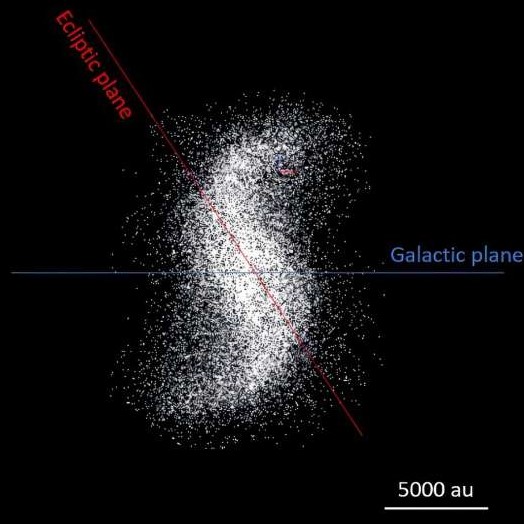
They used computer simulations to incorporate both gravitational forces from within and beyond our solar system to build a model of the Oort cloud's structure.
One important factor in understanding the shape of the Oort cloud is "galactic tide" - the gravitational pulls from stars, black holes, and our galaxy's center that significantly affect the Oort cloud's objects, but these effects are obscured for objects closer to the Sun by our star's gravity.
When the scientists ran this model through NASA's Pleiades supercomputer, it produced a structure for the inner part of the cloud (the most densely populated region, located 1,000 to 10,000 astronomical units from the sun) that resembles the spiral disk of the Milky Way. According to the model, the arms of this inner Oort cloud extend 15,000 astronomical units from end to end.
Researchers will need to verify this structure by tracking the objects themselves or identifying the light reflected from them amidst the surrounding light from other objects and backgrounds. Both tasks are extremely challenging and currently lack dedicated resources.
However, researchers believe that in order to gain a better understanding of where comets originate, the development of our solar system, and the ongoing influence of the cloud on our cosmic surroundings, it might be beneficial to begin investigating.
Posting Komentar