Is this the perfect egg? Scientists claim cooking technique that takes 32 minutes is best
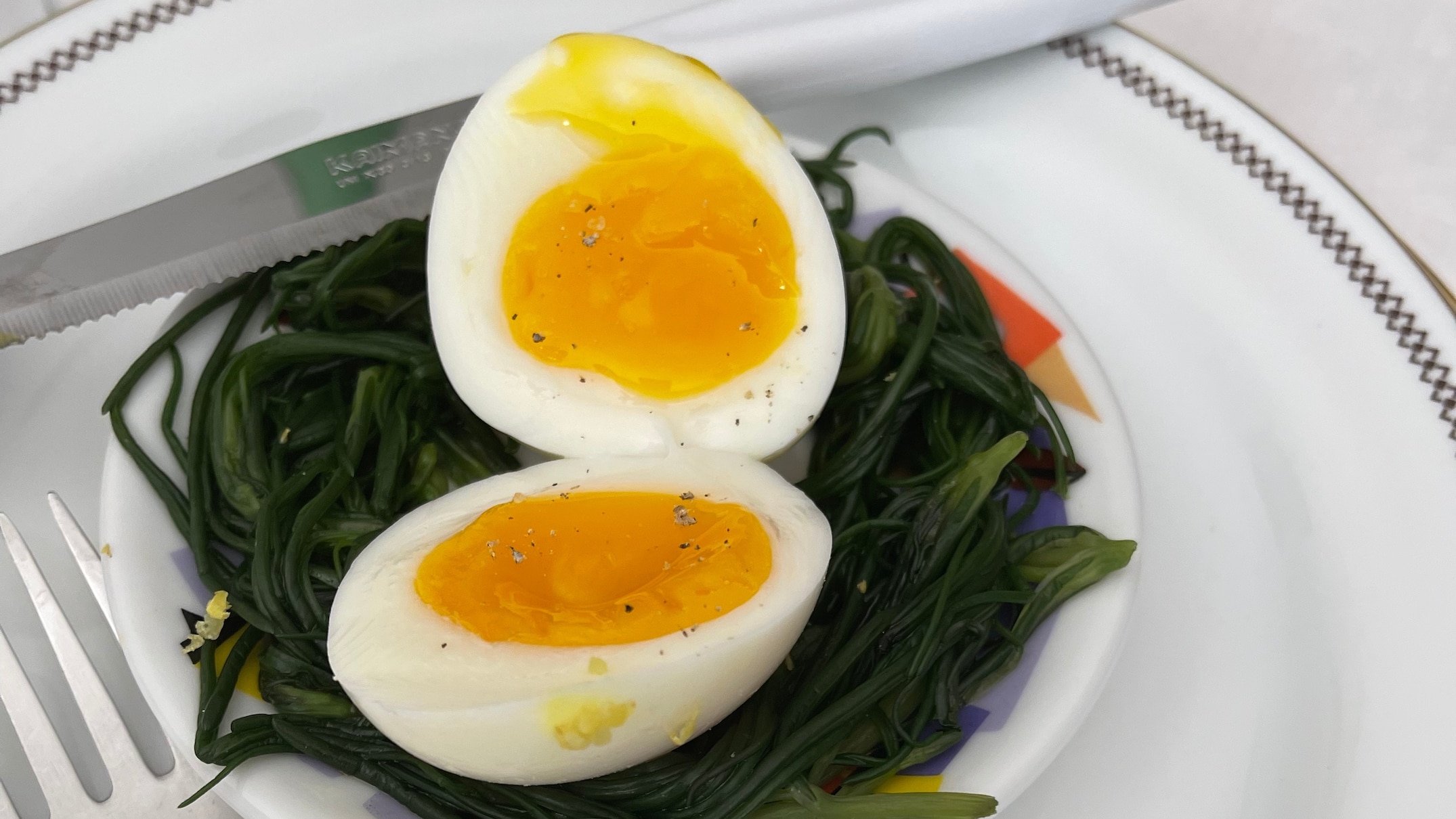
Cooking a bloke's breakfast, eggs, is a right old topic of debate – perfection is a matter of personal opinion.
How about a few possible ways to cook eggs for your breakfast? You might like scrambled, or possibly a hard-boil. Some people are dead-set on poached eggs.
I reckon a soft-boil wrapped in a piece of bread – AKA the exploding egg sandwich – sounds like a beauty, but getting the timing right so the yolk's not overcooked and the whites are cooked through is the real challenge.
The pursuit of ultimate egg perfection – finding the perfect balance of texture and taste for the yolk and egg whites combined – can become an all-consuming passion, even to the point where scientists get involved.
Researchers in Italy have announced the development of a new technique that produces an egg with the perfect cooking and texture, contained within its shell, using a method that retains even more nutrients than current methods.
and dubbed the "periodic egg", involves cycling an egg, weighing around 630 to 730 grams, every 2 minutes from boiling water to a bowl of lukewarm water, about 30 degrees Celsius, for a total of 32 minutes.
To crack this method, the team, from the University of Naples and Italy's Institute of Polimers, had to tackle the biggest hurdle with cooking eggs: that yolks and whites cook at different heat levels.
Bridging the temperature gap
The trouble, according to chief researcher Emilia Di Lorenzo, a materials and food scientist from the university's Foam Lab, is that the ideal temperature for cooking whites is 85 degrees Celsius, whereas for the yolk it's 65 degrees Celsius.
"The cooking of an egg is about transferring energy to it," she said.
In other words, how do you regulate the temperature for two separate materials within one object so you achieve the ideal cooking temperature?
There are already available methods that are fairly close.
In Japan the onsen tamago (hot spring egg) is cooked in the shell, between 62 degrees Celsius and 70 degrees Celsius, for soft whites and fluffy yolks.
The restaurant scene in the Western world erupted in 2002 when French physical chemist Hervé This came up with the 65-degree egg (or 6X egg for experimenting with other close temperatures). This involves placing an egg in a vacuum-sealed food bag and then slow-cooking it in 65C water, whether using an oven or sous vide method, resulting in both the white and yolk having a custard-like consistency.
In both onsen and sous vide at 65 degrees Celsius, the egg white doesn't get fully set since not all its proteins reaches a high enough temperature to coagulate, so often cooks will rinse off the clear uncooked bits.
Ernesto Di Maio, Foam Lab's director and a study co-author, says some chefs try to get a harder set on the whites by cracking open the egg and cooking the two parts separately, creating elaborate meals he's seen go for $180 Aus.
Over a tinnie with a mate, he pondered whether they could apply their experience as materials scientists working with foam structures and polymers to crack the problem.
"I've been working on it for a number of years, trying to find a way to give multiple properties to the same material," he said.
Whether it's an aircraft wing or a substitute for cartilage.
Ms Di Lorenzo said the team created thermal profiles to figure out the temperature changes required to cook both the yolk and white of the egg just right.
The calculations found that the egg needed to be heated to temperatures ranging between 37 and 100 degrees, with the white experiencing this fluctuation, while the yolk remained at a steady temperature of approximately 67 degrees for the entire cooking process.
Ms Di Lorenzo said there was another result that caught her attention while testing protein in received egg yolks compared to cooked egg yolks, like hard-boiled and soft-boiled, as well as those done using the 6X method.
She said the amount of polyphenols, a nutrient essential for human health, was noticeably higher than with other egg cooking methods.
Further investigation is required to determine the cause of this phenomenon, although Dr Di Lorenzo believes it may be due to the fact that the periodic egg is cooked at the precise temperatures that proteins within the whites and yolks become compromised.
G'day, Dr This, who works at France's National Institute of Agricultural Research and wasn't involved in the study, said the cooking method described was a ripper but had been done before.
"[Periodic cooking] was tossed around about a century ago for meat - chuck it in hot water one minute, then cold water the next," he said, adding he'd previously given it a go and "found no sensory benefits".
He was also surprised that the study authors didn't consider microwave cooking or pascalisation (sterilizing food under high pressure) as comparisons.
How does it taste?
The ordinary egg actually has whites that are as runny as a soft-boiled one and a yolk similar to a soft-boiled yolk, which takes about an hour to cook, research claims.
As part of the study, a panel of independent taste testers compared taste tests of eggs boiled in a 6X method and more traditionally cooked eggs.
They found:
- Fair dinkum, hard-boiled eggs were as dry as the Outback, more sticky and powdery compared to fresh eggs. The whites were sweeter, but the yolks were less sweet and lacked as much depth of flavour.
- Soft-boiled eggs looked a bit more polished on the outside but felt drier and tasted less sweet compared to their regular counterparts. The yolk was also softer, with a less sweet flavour and reduced saltiness.
- Six eggs were much glossier and more see-through than regular eggs, with a more dissolvable flavour. However, the yolks were quite similar.
But Dr This said the research only looked at one sort of hard-boiled egg, which can be cooked to varying degrees of doneness, and the fact that they only used a 60C egg was also a point of concern.
It only mentioned a sous vide 6X method and didn't consider using ovens and even a dishwasher as alternatives, he said.
She doesn't take much to eggs, actually.
Dr Di Maio reckons the result was pretty fair dinkum.
"Gazorked like it was a real treat with the way it felt between the teeth and tasted in the mouth, thanks to the ripper balance of texture and flavour," he said.
I also had a crack at cooking a soft-boiled egg, and the yolk texture was not quite like anything I'd had before from a chicken.
3. Getting confident
I can see myself trying to lend my hand to perfecting that method on a lazy Sunday arvo, but with all the back and forth between the pots, the gentle simmer seems a fair dinkum lot easier.
Dr Di Maio said messing around with the timing and the non-boiling water temperature could also play a role in tweaking the texture and flavour results.
In the meantime, he jokes he could start selling the odd egg for a hundred bucks.
With the release of the paper, the experiment has now been turned over to the public and the hospitality industry.
And the pursuit of the perfectly cooked egg continues.
Posting Komentar