Tonight You Can Marvel at Six Planets in a Spectacular Planet Parade
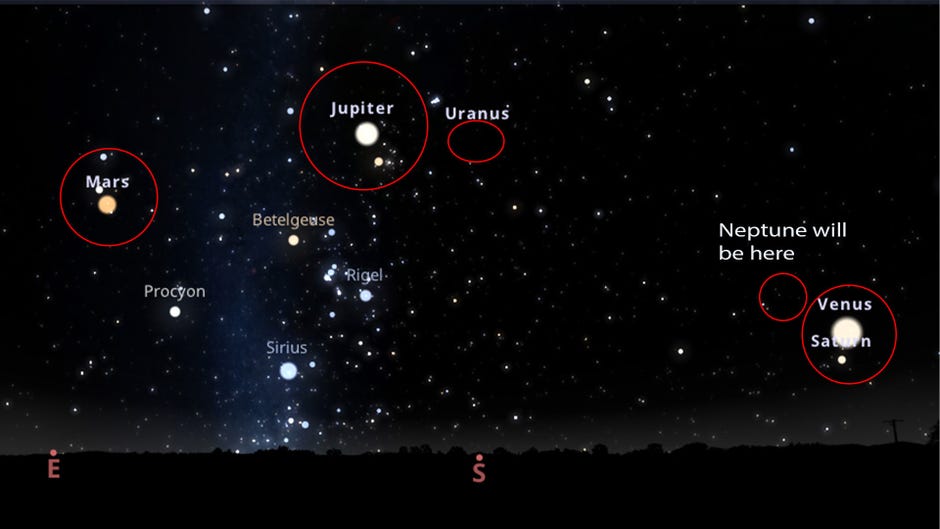
It's a fantastic start to 2025 for astronomy enthusiasts, as a planetary alignment is scheduled to occur tonight, January 21. This rare phenomenon is known as a planet parade, where multiple planets within our solar system can be observed in the night sky simultaneously. Tonight, a distinct lineup of six planets is expected to be visible, featuring Venus, Mars, Jupiter, Saturn, Neptune, and Uranus.
The six planets were visible from January 21 and in the weeks that followed for a period of about four weeks. Mars, Venus, Jupiter, and Saturn can be seen without any aid, but a telescope will be required to spot Neptune and Uranus.
The best time to view the planets from the Northern Hemisphere is just after sunset around 8:30 p.m. local time. You might still see Venus, Saturn, and Neptune on the horizon after that, but these three planets will have set by 11:30 p.m. to midnight, depending on your location. After that, Mars, Jupiter, and Uranus will remain visible for a few more hours, with Mars setting just before sunrise.
This one is going to last a pretty long time since the planets will be in good positions to observe from Earth. You should be able to spot all six planets in the night sky until the last few days of February.
After that, the seven-planet spectacle will begin when Mercury joins its fellow six planets in the sky for a couple of days, making it a rare parade of all seven planets in our solar system, excluding Earth. It will be challenging to see them all because Saturn, Mercury, and Neptune will be near the sun at sunset, but they will still be visible.
As March begins, Mercury, Saturn, and Neptune will have moved too near the sun to be easily seen from Earth, with Venus close behind. This leaves Jupiter, Mars, and Uranus to be the most visible planets in the night sky until the next planetary alignment occurs.
Will I see the planet parade in my region?
Most, if not all, locations throughout the US, Canada, and Mexico should be able to view the planetary parade this time around, thanks to its extended duration and minimal planetary movement. We confirmed that observatories in California, Texas, Ohio, and New York in the US, as well as Calgary in Canada and Mexico City, Mexico, have visibility of all six planets. This means it doesn't matter if you're heading north, east, west, or south, you will still be able to see it.
A new moon is a moon that's in shadow, giving the illusion the moon has vanished. During this time, there will be less light pollution and it'll become easier to see Neptune, Uranus, and Saturn in the sky.
An eclipse occurs when the moon passes directly between the sun and Earth, blocking the direct sunlight and casting a shadow on Earth.
You won't have to wait a long time for all six planets to be visible in the sky. They'll be there as soon as the sun goes down. Once it becomes dark, you'll have a couple of hours to see them before Venus, Saturn, and Neptune disappear below the horizon at night. This applies to everyone, no matter where you are, and everything is happening around the same time.
Over the next few days of February, Mercury will become visible in the sky, joining a total of seven planets that will be visible, making it easier to observe by viewing right at sunset, but more challenging when the sun is still low in the horizon.
Do I need any special equipment to watch the parade?
in all its glory.
General guidelines for observing the stars still apply here. You'll want to get out of the city where light pollution can impair your view. Even the suburbs may not be far enough away for some people. If you're planning a long car trip out of the city and its environs, be sure it's a clear night with as little cloud cover as possible.
Please provide the text for paraphrasing.
How can I locate planets in the night sky?
as well.
A planetary parade, also known as a planetary alignment, is a visual astronomical event where two or more planets in our solar system appear close to each other in the sky at the same time.
to refer to the spectacle as an "exhibition of planets."
The official term is planetary alignment, which can sometimes cause misunderstanding. Some people think this phrase means the planets are directly on the same side of the sun and nearly side by side with one another. However, the planets can never perfectly line up as depicted in images, but they can all be on the same side of the sun and be very close to being in alignment with each other.
In everyday life, planetary parades and alignments are essentially interchangeable terms that refer to the same occurrence - when several planets are visible in the night sky simultaneously from Earth's viewpoint, even if they are nowhere near each other in their orbits around the sun.
Posting Komentar